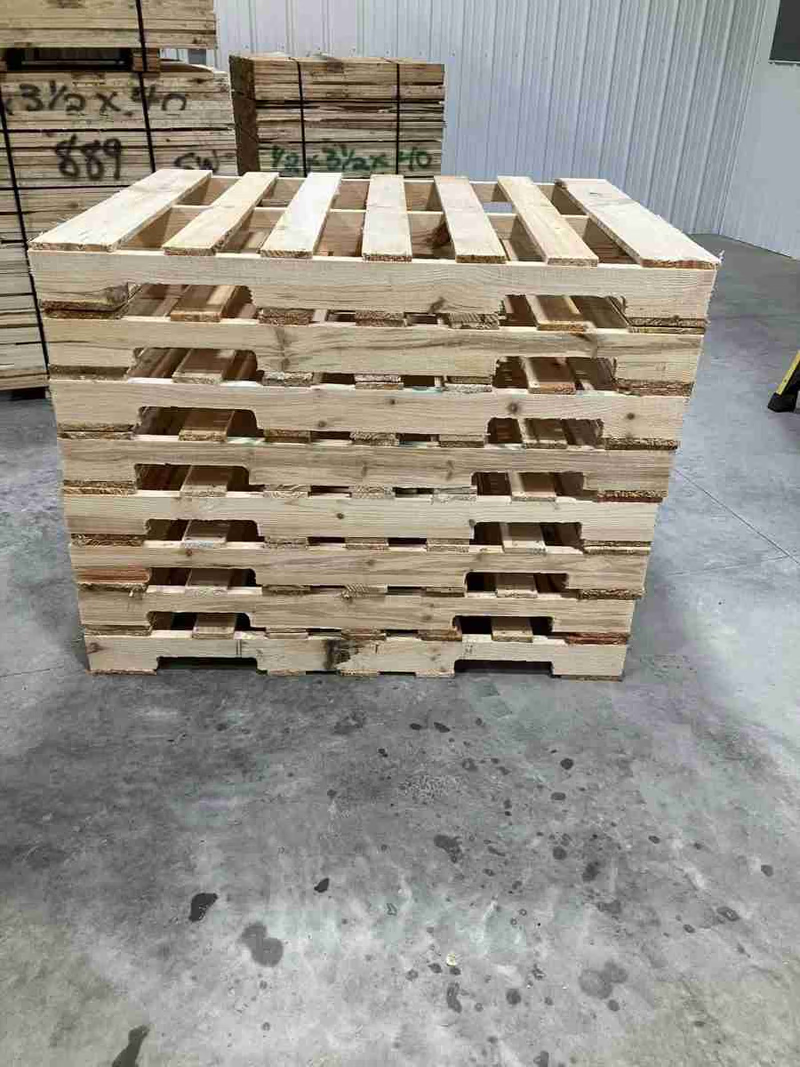
Pallets (also known as skids) are flat transport structures that support goods while being lifted by forklifts, pallet jacks, front loaders, jacking devices, or cranes. Pallets provide structural support for unit loads, making handling and storage easier.
A pallet is typically used to transport goods in shipping containers, which are wrapped with stretch wrap, shrink wrap, or strapping. Due to its ease of use with modern packaging, such as corrugated boxes and intermodal containers commonly used for bulk shipping, it has dramatically replaced older forms of crating like wooden boxes and barrels.
While wooden pallets are the most popular, other recycled materials such as plastic, metal, and paper can also be used as pallets.
Why Use Wooden Pallets for Shipping?
Due to wide range shipping container use, pallets have become more popular because of containerization for transport. There are many pallets that can handle loads up to 2,000 lbs per skid. The United States alone will make about half a billion pallets in 2022, and it will use about two billion pallets.
Stacks of heavy items can be moved easier with pallets. There are several different kinds of forklift trucks that can haul pallet loads, as well as hand-pumped and hand-drawn pallet jacks. In order to utilize pallets economically, it is necessary to construct commercial or industrial buildings. It is more convenient to handle items if they can pass through standard doors and buildings.
This is why most modern pallet standards, such as the euro pallet (800 mm x 1,200 mm) and the US military 35 in x 45.5 in (890 mm x 1,160 mm), are designed to fit through standard doorways.
Pallets can significantly reduce handling and storage costs for businesses that use them, and they can also move materials much faster than those that don't. It is an exception for establishments that move small items, such as jewelry, or large ones, such as trucks or industrial containers.
There is no single international standard for pallets, which makes international trade extremely expensive. It is difficult to establish a single standard due to the variety of needs it would have to meet: fitting through doorways, fitting in standard containers, and bringing low labor costs. When an organization already handles large pallets, it may not be worthwhile to pay the higher handling cost of a smaller pallet that will fit through a door.
Pallet Pooling and Reuse
Pallet pooling and recycling is becoming more and more popular due to costs and the need to focus on core business. Users can receive reusable pallets from some pallet suppliers, which sometimes include tracking devices. Pallets can be supplied, cleaned, repaired, and repurposed by pallet management companies.
Heavy-duty pallets can be reused multiple times and are a form of reusable packaging. Pallets that are lightweight are designed to be used only once. According to EU law, packaging items should be reused rather than recycled or discarded.
The Most Common Dimensions and Sizes
Most wooden pallets are constructed of 3 or 4 stringers that support several deckboards upon which items are placed. The first number in a pallet measurement is the stringer length, and the second number is the deckboard length. Pallets that are square or nearly square help prevent a load from tipping over.
To be accessible to forklifts and pallet jacks, pallets must pass through buildings easily, stack in racks easily, and work in automated warehouses. It is also recommended that pallets are packed tightly inside intermodal containers and vans in order to avoid shipping by air.
Pallet dimensions do not have universally accepted standards, despite the existence of some common standard sizes. Hundreds of pallet sizes are used worldwide by companies and organizations. While no single dimensional standard governs pallet production, a few sizes are widespread.
North American pallets of 48×40 inches are called GMA pallets, and they have stringers measuring 48 inches and deckboards measuring 40 inches. They were standardized by the Grocery Manufacturers Association (GMA).
Depending on the type of pallet, a standard wooden pallet (48 inches by 40 inches by 6 inches or 1,219mm by 1,016mm by 152mm) may weigh between 33 pounds and 48 pounds (15 kg to 22 kg).
It is typical for GMA pallets to weigh 37 pounds (17 kg), and to measure 6-1/2 inches (170 mm) tall. There are three and one-quarter inches (83 mm) of width and five-sixteenths inches (7.9 mm) thick in each of the deck boards. The weight capacity of pallets of other dimensions varies.
Two-Way Entry Stringer Pallets
Pallets with two-way entry are designed to be lifted by their deckboards.
- Cheaper than 4-way entry stringers and blocks
Four-Way Entry Stringer Pallets
Stringers are the best way to lift heavy pallets (or general-purpose systems that may carry heavy loads). There are usually more durable, heavier, and bigger one-way pallets than two-way pallets. They can also be lifted by forklift on any side of the pallet. This can be useful for loading 53 foot dry vans.
- Most common pallet type
- More expensive than 2-way entry skids
ISO Pallet Standards
The International Organization for Standardization (ISO) reviewed and confirmed six pallet dimensions:
Most Popular Type by Region
| MM | Inches | Region |
|---|---|---|
| 1,016 x 1,219 | 48" x 40" | North America |
| 1,000 x 1,200 | 39 x 47.24 | Europe, Asia; similar to 40" × 48". Same footprint as a EUR 3 pallet |
| 1,165 x 1,165 | 45.9 x 45.9 | Australia |
| 1,067 x 1,067 | 42 x 42 | North America, Europe, Asia |
| 1,100 x 1,100 | 43.3 x 43.3 | Asia |
| 800 x 1,200 | 31.50 x 47.24 | Europe |
North American Pallet
Of the top pallets used in North America, the most commonly used by far is the Grocery Manufacturers Association (GMA) pallet, which accounts for 30% of all new wood pallets produced in the United States. The ISO also recognizes the GMA pallet footprint as one of its six standard sizes.
| Size in mm (W × L) | Size in inches (W × L) | Industries Using |
|---|---|---|
| 1,219 x 1,016 | 48 × 40 | Standard size, Food Manufacturers, Government |
| 1,067 x 1,067 | 42 × 42 | Custom build, Beverages, Paint |
| 1,219 x 1,219 | 48 × 48 | Steel and Plastic Drums, Gaylord Boxes, IBC Totes |
| 1,219 x 1,067 | 48 × 42 | Chemical, Beverage |
| 1,016 x 1,016 | 40 × 40 | Dairy Production |
| 1,219 x 1,143 | 48 × 45 | Car Industry, Gaylord Boxes |
| 1,118 x 1,118 | 44 × 44 | Drums, Chemical, Custom Builds |
| 914 x 914 | 36 × 36 | Euro Pallet |
| 1,219 x 914 | 48 × 36 | Beverage, Shingles, Paper Mills |
| 889 x 1,156 | 35 × 45.5 | Military |
| 2,240 x 2,740 | 88 × 108 | Military Air Cargo |
| 1,219 x 508 | 48 × 20 | Retail |
EuroPallet
| Pallet Type | Dimensions (L × W × H) |
|---|---|
| EUR / EUR 1 | 800 mm × 1,200 mm × 144 mm (31.50 in × 47.24 in × 5.67 in) |
| EUR 2 | 1,200 mm × 1,000 mm × 144 mm (47.24 in × 39.37 in × 5.67 in) |
| EUR 3 | 1,000 mm × 1,200 mm × 144 mm (39.37 in × 47.24 in × 5.67 in) |
| EUR 6 | 800 mm × 600 mm × 144 mm (31.50 in × 23.62 in × 5.67 in) |
Australian Standard Pallets
A common pallet size in Australia but very rare elsewhere is the Australian standard pallet. In the RACE container of the Australian Railway, it fits perfectly in the square pallet made of hardwood, measuring 1,165 mm by 1,165 mm (45.87 in by 45.87 in). It is not compatible with the standard ISO shipping containers used around the world, which are 20 feet (6.1 m) and 40 feet (12 m).
Standard pallets in Australia are usually made of hardwood, but lighter wood can also be used to create pallets that can be used as disposable pallets with 16 millimeter boards. These pallets are commonly used in warehouses and storage facilities because of their size and shape, which allow them to be directly transferred from the transportation process to the warehouse racking.
It dates back to World War II that the Australian Standard Pallet was developed, while ISO containers were developed in the late 1950s. Pallets, including the GMA pallet, require less dunnage, are square, and leave less waste space than ISO containers despite their dimensions.
The Australian Government adopted the internationally accepted ISPM 15 wood packaging material regulations in 2010 (previously, hardwoods were used and were more expensive).
Universal Pallet Standards
Pallet standards are established and promulgated by a variety of organizations and associations around the world. There are some who strive to develop universal standards for pallet dimensions, types of materials used in construction, and performance standards.
There are also organizations that focus on pallet standards for specific industries (such as groceries) or materials (such as wood).
National Wood Pallet and Container Association
The National Wood Pallet and Container Association (NWPCA) is a trade organization based in the United States representing the interests of wood pallet and container manufacturers.
U.S. Department of Defense
MIL-STD-1660, the standard description of palletized unit loads, is maintained by this organization for the use of the U.S. Armed Forces and some allies.
It is typical for DOD Unit loads to use pallets measuring 40 in by 48 in (1,016 mm by 1,219 mm), to weigh less than 4,000 pounds (1,814 kg), to be weatherproof, and to stack 16 feet (4.88 m) high. The pallets are usually steel, the straps have notch seals, the plywood is outdoor, and the plastic film is often used. Forklifts and pallet jacks, impact, drop tests, tipping, water-retention, and disassembling are all described in the standard.
European Committee for Standardization
The European Committee for Standardization (CEN) publishes standards for pallets. In spite of the voluntary nature of the standards, many companies and organizations involved with transportation have adopted them. As a general purpose pallet, ICS 55.180.20 is the most widely used standard produced by CEN.
International Regulation
Pallets shipped across national borders must comply with the International Plant Protection Convention (IPPC), which stipulates that they must not be capable of carrying insects and plant diseases. In ISPM 15, these pallets are specified as complying with the standards.
ISPM 15 does not allow pallets made of raw, untreated wood. Compliant pallets (or other wood packaging materials) must be debarked and treated under the supervision of an approved agency using one of the following methods:
- Heat Treatment (HT): A minimum temperature of 56°C (132.8°F) must be reached for at least 30 minutes during the heating process. HT is inscribed near the IPPC logo on pallets treated using this method.
- Methyl Bromide (MB): Methyl bromide is required for chemical fumigation of wood. This method results in pallets bearing the IPPC logo and the initials MB. All EU member states have banned methyl bromide as a treatment since 19 March 2010 due to its potential harm to the stratospheric ozone layer.
It is required to stamp HT or MB on both sides of treated wood pallets, depending on whether they have been heat treated or methyl bromide treated.
ISPM 15 regulations do not apply to pallets made from non-wood materials, such as steel, aluminum, plastic, or engineered wood products, such as plywood, oriented strand board, or corrugated fiberboard.
The Wooden Pallet
Pallets of this type are by far the most common. Pallets made of wood are lightweight, stiff, durable, and cost-effective. Further, wood pallets can also be refurbished and reused thanks to a broad pallet recycling infrastructure. Furthermore, timber components can be used to build pallets of any size. Wood pallets have the following general characteristics:
- In the USA, the standard size of a wood pallet is 48" x 40"
- There are typically three or four stringers that are attached to a wooden pallet; these stringers have been inserted in order to support the deck boards, onto which the goods are placed
- These pallets are usually made from what is called "waste" lumber, which, while it may not look as good as furniture-grade wood, is just as strong
- A foam padding and a protective support are provided for the saddles
- As they are manufactured using "waste" lumber, they do not cause any harm to nature since no trees are cut down in order to make them
- It is possible to reuse wood pallets as pallets or as beautiful objects. These pallets can be re-used and recycled
- There are many advantages to using pallets made from pooled wood: durability, cost, and environmental sustainability
Wood Pallet Reconditioning Options
Grade A Pallets (#1)
This is what we consider to be an accurate definition of a Grade A pallet, but there is a great deal of disagreement when it comes to what constitutes such a pallet:
- On top of the pallet, there are seven wooden boards
- At the bottom of the pallet there are five wooden boards
- Some pallets may contain 6" lead boards, but we cannot guarantee that all pallets will contain 6" boards
- Generally speaking, the spacing between top decks is between 2.5" and 3.5" depending on the manufacturer
- Each stringer measures 1-1/2" x 3-1/2" and there are three of them in total
- 4-way partial entry
- Flush
- There should be no damage to the stringers or boards
- Whenever there is a split in the stringers, it may be necessary to mount repair plates on each stringer in order to strengthen it
- There should be no pests or contagions in the wood
- Also known as a #1 or Premium GMA
Grade B (#2) Wooden Pallets
Mix of hardwood and softwood, repaired with stringer inserts for rackable pallets and one-way shipping.
The dimensions of Grade B pallets are 48 x 40 inches. The boards and stringers may have some minor damage to them, but they can still be used as they are in good working condition. There are some signs of wear and tear on them since they have been used multiple times.
It is recommended that an additional runner is placed alongside the broken or cracked piece of wood in order to repair or reinforce it. A pallet classified as "Grade B" is one that has already been used previously and usually has some sort of damage on one of its stringers (if it has any).
There are a number of treatments that are applied to pallet wood so that it is more sturdy and less susceptible to insects.
Hardwood vs Softwood
Softwood pallets are often considered to be the cheapest pallets, since they are made of a soft material that can be discarded as trash along with other wrapping elements at the end of the journey. Simple stringer pallets are used here, in which the pallets can be lifted on both sides and can be stacked.
Pallets that are made of hardwood blocks, plastic pallets, and metal pallets are slightly more complex to lift as they can be lifted from all four sides. It is usually the case that these more expensive pallets are returned to the sender or are resold once they have been used. It is also common for "four way" pallets to be color-coded according to the loads they can carry, and other attributes that make them useful.
Due to wood pallets' susceptibility to bacterial and chemical contamination, such as E. coli problems in food and produce transportation, and even insect infestation, the use of ISPM 15 is necessary to prevent serious biohazard risks.
Depending on the pallet's intended use, including the FDA, storage, chemical and export requirements, the type of wood that is to be used, the weight of the load, whether it is recycled, hard, soft, kiln dried or a combination (new and recycled), and the type of fasteners that are needed to hold the pallet together.
As a result of increases in the price of lumber and labor during the COVID-19 pandemic, the price of wooden pallets reached a record high during this period.
Different Types of Pallets
Despite the fact that pallets come in all sorts of different sizes and configurations, they can be divided into two very broad categories: "stringer" pallets and "block" pallets.
Stringer Pallets
A stringer pallet was one of the first wooden pallet designs, and it is still one of the most popular models today. Stringers make up most of the pallets used across the country and are typically 48 x 40 in size. In order to make a frame, three or more parallel pieces of timber are used (this is called a stringer frame). It is then necessary to attach the top deckboards to the stringers in order to construct the pallet structure. It is possible to cut a notch into the stringer pallets so that a "four-way" partial entry is possible. The stringer pallet can be lifted by a forklift in all four directions, but it is more secure to lift it by the stringers.
Block Pallets
Block pallets are also known as "Full 4-way entry". They are meant for heavier and bulk loads. Often longer lasting and more expensive than the standard stringer pallets. That being said they are harder to repair and therefore less valuable to pallet recyclers.
Carrier Blocks
Specifically designed pallets for lumber carriers are known as carrier blocks.
Flush Pallet
Flush pallets are pallets with deck boards that are flush with the stringers and stringer boards along the ends and sides of the pallet. This pallet is constructed in such a way that there is no overhang and the decks, both bottom and top, fit flush with the stringers on all sides so that the pallet is constructed as close to the ideal as possible.
Wing Pallets
The wings of the pallet are made with an overhanging deck board or deck end attached to the outside edge of the stringers or stringboards so that they can:
- Increase the unit-load area
- Increase the load-bearing capacity of the pallet
- Reduce the splitting of deckboard ends with the use of fasteners
- Using bar slings suspended from a crane, it is possible to lift a pallet with the help of bar slings
Perimeter Base Pallet
Almost all stringer pallets as well as some block pallets are made with "unidirectional bases," which means the bottom boards are oriented in one direction only. Often, automated handling equipment can work faster and more efficiently if the bottom boards of a pallet are oriented in both directions. In some cases, a pallet doesn't have to be turned to rack it, and it's less sensitive to pallet orientation.
Improvements to Quality
You can usually improve a pallet for the least money by specifying better nails. It's often helpful to control the coefficient of friction on non-wood pallets so they don't slide off forklifts. Stronger pallets are more durable, and automated equipment can handle them easier. You can use two-way pallets with unnotched stringers if you don't need to lift it from all four sides, and you'll get extra rigidity and strength.
Providers can meet target requirements by specifying flatness and water content tolerances. A pallet inspection, either in person or by a third party (like "SPEQ" inspected pallets), offers extra quality assurance.
How Wooden Pallets Are Made
- Selection of materials
- Cutting the wood to meet the needed dimensions
- Notching
- Placing nails in wooden pallets
Fire Hazards
It is possible for both wood pallets and plastic pallets to catch fire. As per the National Fire Protection Association, both types "should be stored outdoors or in detached structures" unless sprinklers are installed.
Contamination Risk
Transporting food on wooden pallets can introduce pathogens like E. coli or Listeria. An independent microbiology lab tested 70 wood pallets and 70 plastic pallets that had been loaded with perishable products and shipped to an end user. According to the results, 10 percent of the wood pallets (7 pallets) were positive for E. coli, while 1.4% of the plastic pallets (1 pallet) were positive.
Air Cargo Pallets
Air Cargo Pallets are interchangeable and detachable floor panels. For cargo aircraft, the cargo pod is ideal for transferring air cargo that is less than 1 in (25 mm) thick. The military's thicker 463L Master Pallet has evolved into many civilian types over the last six decades. An air cargo pallet combined with a cargo net is considered an aircraft "Unit Load Device" for which integrity must be checked before it is used on the aircraft. Rollers or ball-mats are used as ground equipment (forklifting is prohibited when pallets are loaded).
Pallet Boxes
In pallet boxes, there are four walls and possibly a lid on top of the pallet. Pallet boxes can be stacked when fully loaded, unlike pallets. During stacking, a lid may also be added to improve stability.
The space can be used more efficiently when pallet boxes are stacked on top of one another, which leads to more space being saved in warehouses and more truckload capacity being saved.
During logistical movements and transport, pallet boxes are also advantageous for storing and securing goods.
Additionally, pallet walls can be laid flat on the pallet using collapsible pallet boxes. During empty return transport, less space is required.
There is a close relationship between bulk boxes and palletized boxes; they are usually large, separate boxes.
History of the Pallet
Historically, skids can be traced back to the 1st millennium B.C. in Ancient Egypt and Ancient Mesopotamia. Pallets were extensively used during World War II due to the development of the forklift and the demands of logistics operations.
Pallets used in the early modern era are few and far between, with only a few patents demonstrating their development. In the late 1930s, pallets became more commonplace with the newer forklift types.
The earliest known example is Howard T. Hallowell's "Lift Truck Platform" patent from 1924. A pallet designed to complement a new pallet jack design was patented in 1937 by George G. Raymond and William C. House. Both features are still in common use today. Pallets with steel stringers are shown in a 1939 patent from Carl Clark.
As a result, inventions developed during World War II were often patented after the battle, like the four-way pallet patented by Robert Braun in 1945 and the disposable pallet patented by Norman Cahners in 1949. As described by Darling Graeme in 1949, the four-way pallet is a modern innovation.